


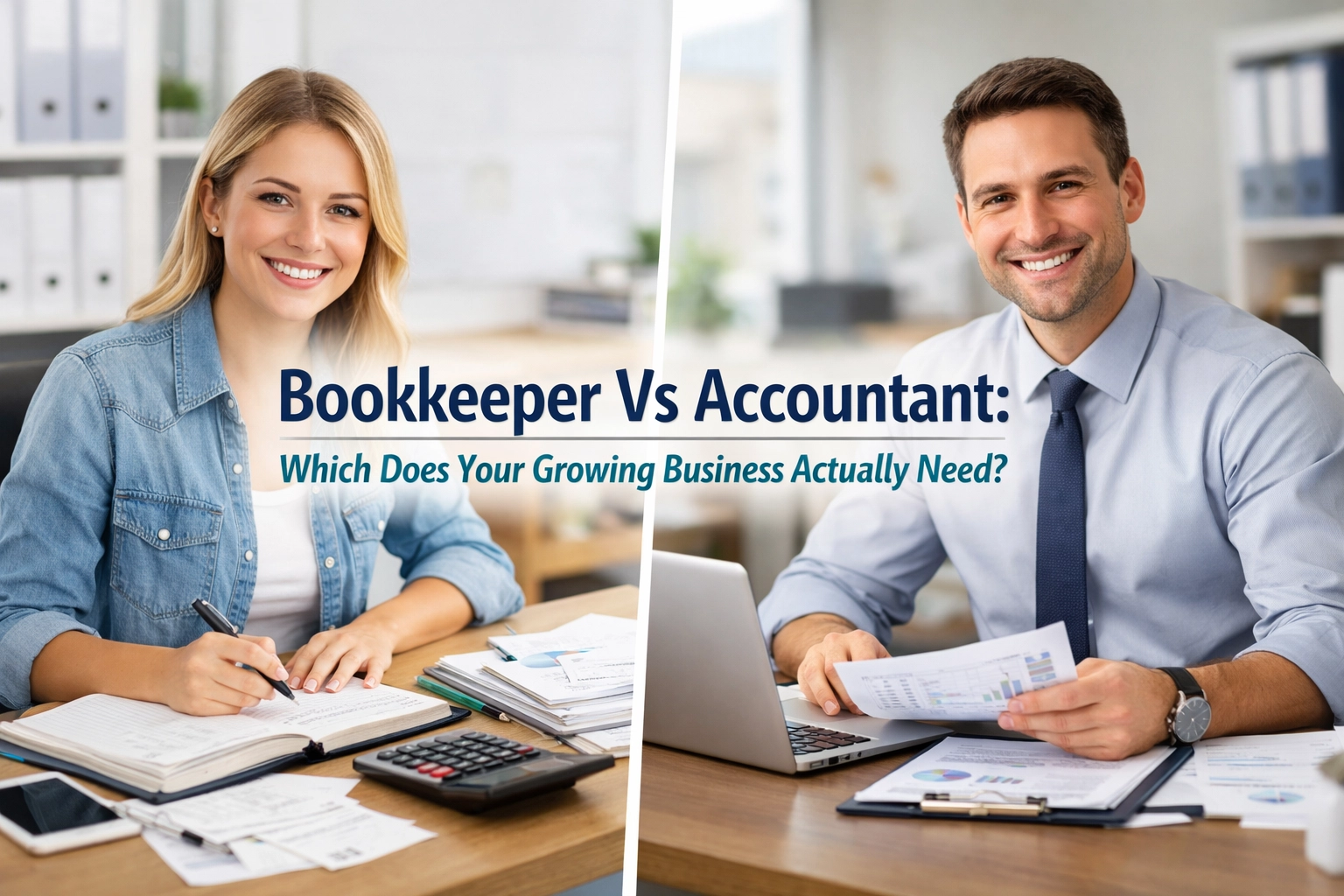
Here's a question you've probably Googled at 11pm on a Tuesday: Do I need a bookkeeper or an accountant?
It's one of those grown-up business moments, isn't it? Like choosing between a solicitor and a barrister, or knowing when to call a plumber versus an electrician. You know they're both important, but what's the actual difference, and which one will stop your business from falling apart?
Let me clear this up for you, because it's simpler than you think (and probably not what you've been told).
The difference in plain English
Think of it like this: a bookkeeper is the person who keeps your financial house tidy every single day, while an accountant is the expert you call in once a year (or quarterly) to make sense of it all and tell HMRC what they need to know.
Bookkeepers handle the day-to-day stuff:
- Recording every transaction (yes, even that £3.50 coffee you bought on the business card)
- Managing your invoices and making sure you're actually getting paid
- Running payroll so your team gets paid on time
- Handling VAT returns and submissions
- Keeping your purchase ledger in order
- Making sure your bank reconciliations are spot-on
Accountants handle the big-picture, year-end stuff:
- Preparing your annual accounts for Companies House
- Submitting your tax returns and dealing with HMRC
- Tax planning (the legal kind, not the dodgy offshore kind)
- Strategic financial advice for growth
- Audits and compliance
- Forecasting and financial modelling

Both roles are crucial, but here's where most growing businesses get it backwards.
The mistake: hiring an accountant too early (and forgetting the daily support)
I see this all the time. A business starts making decent money, the founder panics about tax, and immediately hires an expensive accountant. Which is great! Except… their day-to-day books are an absolute mess.
The accountant then spends hours (that you're paying for at £150+ per hour) just trying to figure out what actually happened during the year. They're digging through shoeboxes of receipts, chasing missing invoices, and basically doing bookkeeper work at accountant rates.
It's like hiring a Michelin-star chef to wash your dishes. Sure, they can do it, but it's not the best use of anyone's time or money.
Meanwhile, the daily stuff that actually keeps your business running, paying suppliers, chasing late invoices, making sure your VAT return is filed on time, gets neglected until it's a crisis.
Here's the thing: most growing businesses need solid, consistent bookkeeping support before they need high-level accounting advice.
Why clean books save you serious money
Let's talk numbers for a second (I promise this won't hurt).
Say your accountant charges £150 per hour. If they receive clean, organized books from a bookkeeper, they might spend 5 hours on your year-end accounts. That's £750.
But if they receive a year's worth of chaos? That same job could take 15-20 hours. Now you're looking at £2,250-£3,000. Ouch.

Good bookkeeping saves you money on accounting fees because:
- Your accountant spends time on strategy, not data entry
- Year-end accounts take a fraction of the time
- Tax planning becomes proactive, not reactive
- You avoid penalties for late or incorrect submissions
- Your accountant can actually give you useful advice based on accurate numbers
It's honestly one of the best investments you can make. Clean books from a professional bookkeeper mean your accountant can focus on what they do best: helping you grow and protecting you from tax problems.
The bookkeeper advantage: daily support that actually helps you run the business
Here's what I love about proper bookkeeping support (and yes, a little shameless honesty here, this is what we do at 6 4 G Ltd in sunny Worthing).
When you have a dedicated bookkeeping team, you're not just getting someone to tick boxes. You're getting:
Real-time visibility into your finances
- You know what's coming in and going out
- You can make decisions based on actual data, not guesswork
- You spot problems early (like that client who's 60 days overdue)
Proper payroll management
- Your team gets paid correctly and on time
- PAYE and CIS are handled properly
- You're not lying awake worrying about RTI submissions
VAT sorted without the stress
- Returns filed on time, every time
- You're claiming back everything you're entitled to
- No surprise tax bills because someone forgot to account for VAT
Outsourced payroll UK services that actually work
- Whether you're dealing with standard employees, CIS contractors, or a mix
- No more scrambling at month-end
- Professional support that scales as you grow

The best part? You're not doing any of it yourself. Which means you're free to do what you're actually good at: running and growing your business.
Why 6 4 G Ltd is the perfect middle ground
Okay, here's where I get to talk about what makes us different (and why small business bookkeeping in Worthing has never looked so good).
Most businesses face a choice: hire someone in-house (expensive, risky if they leave), use a solo freelancer (what happens when they're on holiday?), or go with a massive faceless firm (good luck getting anyone on the phone).
We're the middle ground. You get team-level expertise without having to employ an entire accounts department.
Here's what that actually means:
- You're not relying on one person: if someone's off sick or on holiday, your work still gets done
- You get specialists in different areas (payroll, VAT, credit control) rather than a generalist
- You have consistency and backup, so nothing falls through the cracks
- You get proper business growth support as you scale
- We're real people in Worthing (not a call centre in who-knows-where)
And crucially: we give your accountant clean, organized books. Which saves you money and means your year-end isn't a nightmare.
We handle the daily grind: recording transactions, managing payroll, chasing invoices, filing VAT returns: so your accountant can focus on the strategic stuff. It's the best of both worlds.

So… which do you actually need?
The honest answer? Eventually, you need both.
But if you're a growing business and you're trying to figure out where to invest first: start with solid bookkeeping.
Get your day-to-day finances in order. Make sure your books are clean, your payroll is professional, your VAT is sorted, and your invoices are actually getting paid.
Then bring in an accountant for the strategic, year-end stuff. They'll thank you for it (seriously, accountants love working with clients who have clean books), and you'll save a fortune in fees.
Final thought
Running a business is hard enough without spending your evenings wrestling with spreadsheets and wondering if you've recorded that invoice correctly.
The difference between a bookkeeper and an accountant isn't just about job titles: it's about what your business actually needs right now. And for most growing businesses, what you need is someone handling the daily financial tasks so you can focus on growing.
That's where we come in.
Not sure what support you need? Let's figure it out together. We're happy to have a chat about where your business is at and what would actually help. No pressure, no sales pitch: just honest advice from people who genuinely want to help your business succeed.
Get in touch with us here and let's have a proper conversation about what you need.
Because the right financial support shouldn't feel complicated( it should just make your life easier.)